COMPREHENSIVE TESTIMONY
Chronicles of a Revolutionary Life
CHAPTER I
Early Life, Heritage & Self-Education in Pauri
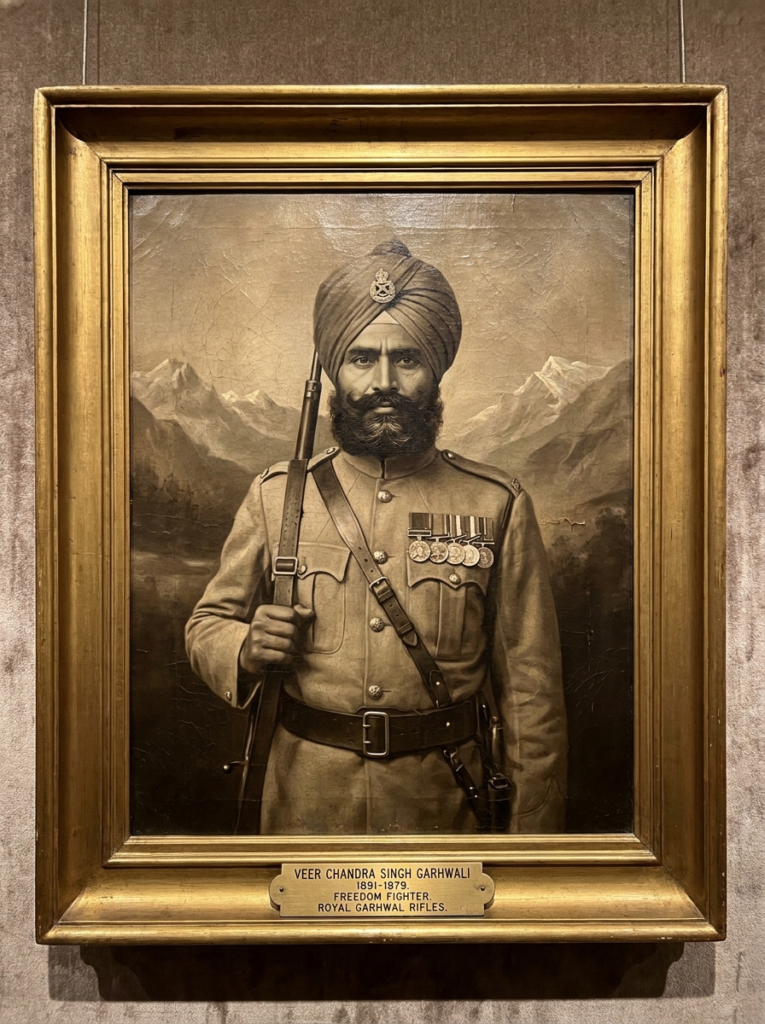
Veer Chandra Singh Bhandari was born on 25 December 1891 in Masi village of Pauri Garhwal. His ancestry traced directly to Chandpurgarh, the historic sovereign citadel of Garhwal kings before shifting to Srinagar. Despite descending from royal warriors, his father, Jalloth Singh Bhandari, lived as an impoverished peasant tenant under the rugged conditions of the central Himalayas.
In rural Garhwal during the 1890s, colonial infrastructure offered virtually zero schools for peasant children. Unable to afford tutoring, Chandra Singh developed literacy through painstaking self-study—learning Hindi, basic Urdu, and Devanagari script by burning pine torches late into mountain nights. This unyielding discipline instilled in him a critical consciousness that set him apart from conventional colonial enlistees.
CHAPTER II
The Great War Theatres: From Lansdowne to France & Mesopotamia
On 3 September 1914, following the outbreak of World War I, Chandra Singh walked from his village to the Lansdowne Cantonment, the headquarters of the Garhwal Rifles, and enlisted in the imperial army. Recognized immediately for his imposing stature, sharp intellect, and disciplined mountain stamina, he rose rapidly through the ranks.
On 1 August 1915, his battalion sailed for Europe. In France, amid the brutal trench warfare of the Western Front, he witnessed the sheer slaughter and imperial exploitation of Indian manpower. Returning to Lansdowne in February 1916, he was redeployed to the harsh Middle Eastern deserts in 1917 to fight the Ottoman forces in the Battle of Mesopotamia. In 1918, he participated in the British capture of Baghdad.
Following the armistice, the British military systematically demoted many Indian non-commissioned officers who had earned battlefield promotions, returning Chandra Singh from Havildar to simple soldier. Deeply insulted by this colonial ingratitude, he resolved to resign; however, British officers dissuaded him by promising restorative promotion, sending him on temporary home furlough.
CHAPTER III
Awakening & Contact with Mahatma Gandhi & Arya Samaj
During his furlough in 1919–1920, Chandra Singh was exposed to the surging nationwide fervor of Mahatma Gandhi’s Non-Cooperation Movement. Traveling through northern stations, he came into close contact with Arya Samaj reformers and patriotic literature. For the first time, he recognized that the weapon in his hands served not motherland protection, but the subjugation of fellow Indians.
In 1920, his battalion was ordered to Waziristan along the rugged North-West Frontier. After successful mountain pacification, his rank was restored, eventually elevating him to Havildar Major in the Khyber Pass sector. By this time, colonial intelligence officers noted his quiet affinity for nationalist writings and swadeshi sentiments, yet could not anticipate the magnitude of the moral stand he was about to orchestrate.
HISTORIC DEFENSE AT COURT MARTIAL
Barrister Mukandi Lal & The Commutation of Martyrdom
When the British military command in Peshawar charged Chandra Singh and his fellow Garhwalis with high treason and armed mutiny, execution by firing squad seemed certain. The renowned nationalist and Garhwali jurist Barrister Mukandi Lal took up the defense at grave personal hazard. Arguing that soldiers could not be compelled by military law to commit unprovoked slaughter on peaceful noncombatants, Mukandi Lal mounted a brilliant legal contest that forced the imperial judges to commute the death sentences to rigorous multi-year imprisonment.
CHAPTER IV & V
Imprisonment, Quit India (1942) & The Wardha Pilgrimage
Sentenced to 14 years in 1930, Chandra Singh was cast into Abbottabad Central Jail, later shuffled between Bareilly, Dera Dun, and other imperial penitentiaries to prevent him from stirring fellow inmates. After 11 years of rigorous solitary confinement, he was finally released on 26 September 1941—only to find his entry into his beloved Garhwal territory strictly banned by governor decree.
Destitute and stateless, he sought shelter at Sevagram Ashram in Wardha with Mahatma Gandhi. Gandhi was deeply moved by Chandra Singh’s towering moral stature, famously declaring: “If I had one more Chandra Singh Garhwali, India would have attained Swaraj without delay.”
When Gandhi issued the call for the Quit India Movement in August 1942, Garhwali immediately traveled to Allahabad to lead clandestine defiance against colonial authorities. He was promptly rearrested and incarcerated for an additional three years until 1945. It was only in December 1946, with the active intervention of peasant groups and progressive comrades, that he was finally allowed to re-enter the Garhwal hills.